
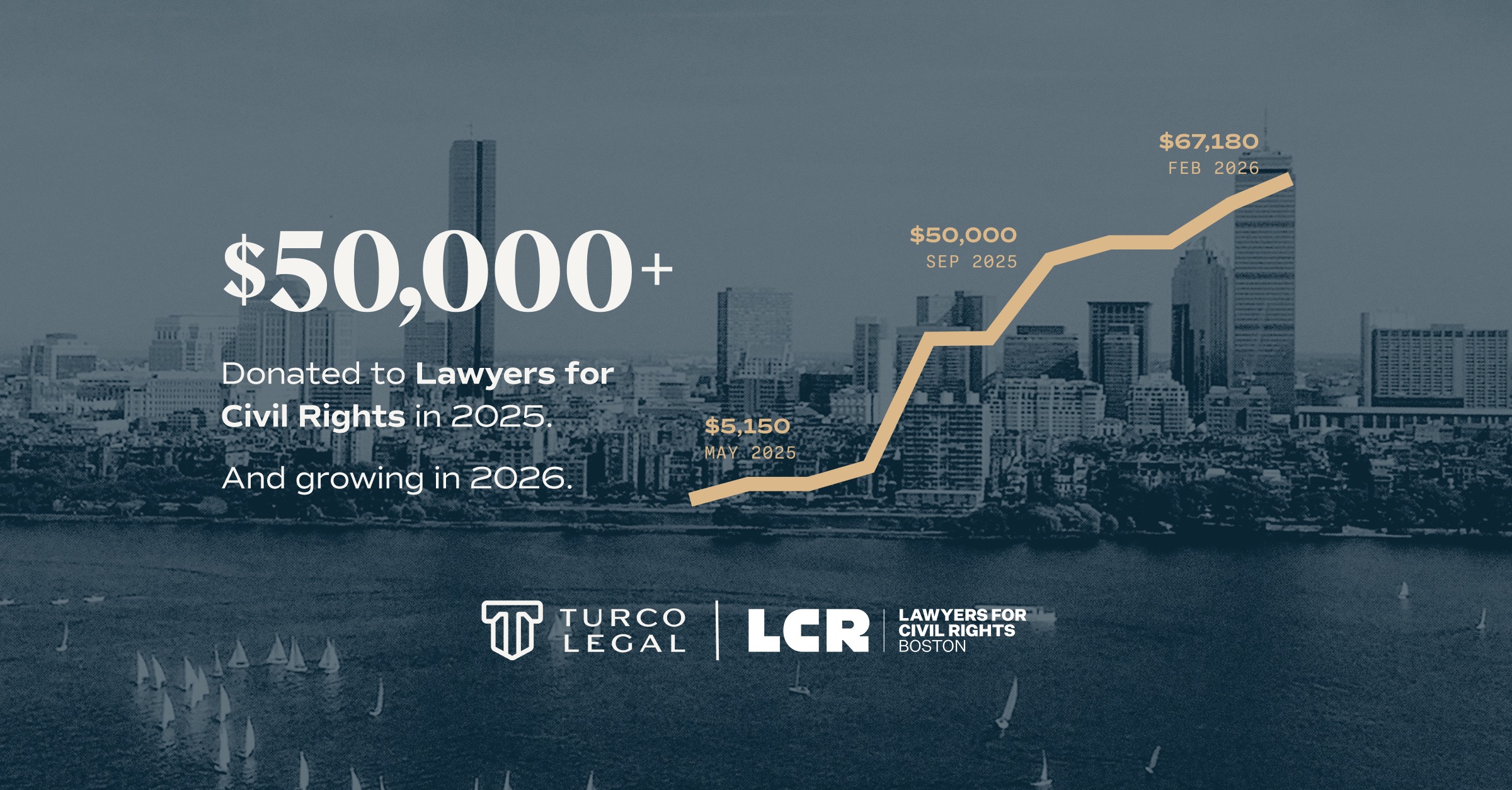
In May 2025, Turco Legal made an initial $5,000 donation to Lawyers for Civil Rights. That gift was only the beginning.
From there, we made a deeper commitment. Turco Legal would donate 10% of its profits. These funds support Lawyers for Civil Rights, a Boston-based civil rights organization. Its work is urgent, courageous, and necessary now more than ever. As we write this, our giving has grown to more than $67,000 through February, and our commitment remains strong.
We share that update with gratitude, but also with purpose.
Because this is not just a story about charitable giving. It is a story about what sustained support makes possible. This is a story about what happens when legal resources protect constitutional rights.
It also shows how lawyers defend vulnerable communities. It highlights efforts to preserve the rule of law under pressure. And it is a story about Lawyers for Civil Rights (LCR) and the extraordinary work its attorneys and staff have carried out over the last year.
LCR’s mission is clear. It works with people of color, immigrants, and low-income communities to fight discrimination. It fosters equity and pursues justice through creative and courageous legal advocacy, education, and economic empowerment. LCR provides free, life-changing legal support to individuals, families, and small businesses in partnership with law firms and community allies.
That mission is not abstract. This work shows up in court filings and emergency advocacy. It also appears in public records requests and policy work. Across communities, it is present in education and impact litigation. The efforts span immigrant rights, education, and housing. Work in this area includes voting rights and employment issues. It further addresses police accountability and economic justice. The scope of the work led us to avoid a one-time gift and instead stay involved. We wanted to build a model of recurring support. It would sustain long-term, high-impact civil rights litigation communities rely on. As LCR and Turco Legal wrote in a recent op-ed, Turco Legal pledged 10% of firm proceeds to LCR. In one year, that support exceeded $50,000. The model aims to provide predictable, durable funding for civil-rights advocacy.
Over the past year, LCR has shown exactly why that kind of sustained support matters.
One of the clearest examples is LCR’s work standing up to increasingly aggressive and unlawful immigration enforcement. LCR’s 2025 Annual Report describes “unprecedented attacks” on immigrant communities. LCR responded by defending vulnerable groups and upholding the rule of law. It also filed early civil rights complaints to guide advocates nationwide.
That work is not theoretical. It is intensely human.
Consider the Ramirez Sanan family in Chelsea. In December 2025, LCR filed a Federal Tort Claims Act complaint for Hilda Ramirez Sanan. She is a lawful permanent resident of over 20 years. Her children are U.S. citizens. According to the complaint, armed and masked ICE officers blocked the family’s car near Chelsea District Court. They allegedly shattered the windows without identifying themselves and forcibly removed the family. Ms. Ramirez Sanan was violently restrained, traumatizing her 13-year-old autistic son. The complaint alleges that officers ignored her lawful status and never produced a warrant. They then tried forcing her into an unmarked vehicle before authorities intervened.
The complaint goes on to describe the aftermath: recurring nightmares, physical injuries, ongoing treatment, financial strain, and a family living with the profound psychological consequences of a lawless and violent encounter. That is the sort of case many people will read about for a moment and then move on from. LCR does the opposite. It documents, investigates, and litigates to seek accountability. And it forces the legal system to confront conduct that should never be normalized.
The Ramirez Sanan matter is part of a broader body of immigrant-rights work that LCR has undertaken. In its Annual Report, LCR highlights its lawsuit protecting birthright citizenship, its litigation defending sanctuary cities like Chelsea and Somerville from federal retaliation, its support for families targeted by violent ICE operations, and its work challenging attempts to terminate humanitarian protections for Haitian and Venezuelan immigrants. The report makes clear that LCR is not just reacting to one incident at a time. It is building doctrine, precedent, and legal infrastructure in real time.
That same pattern appears in LCR’s recent work involving children and young people. In March 2026, one of LCR’s clients, Michelle Ramirez Sanan, was set to testify before Congress at a bicameral hearing examining ICE abuses against children. Her appearance followed LCR’s filing of a Federal Tort Claims Act complaint on behalf of her family, and it placed local trauma into a national accountability forum. LCR’s presence in that hearing matters. It means legal advocacy does not stop at the courthouse door; it moves into public oversight, legislative scrutiny, and institutional reform.
LCR has also been deeply engaged in defending the due process rights of youth closer to home. Its Annual Report describes work demanding answers after a 13-year-old in Everett ended up in ICE custody following a police interaction. LCR filed a public records request and called for a state-led investigation into whether local police unlawfully coordinated the child’s transfer to ICE custody, emphasizing that state law prohibits local law enforcement from prolonging detentions to assist immigration officers. That is a critical intervention at the intersection of juvenile rights, immigrant rights, and police accountability.
Another major area of impact has been education. LCR’s Annual Report explains that it continues to respond to a growing wave of racial bullying in schools, especially as federal civil-rights oversight has been weakened by the dismantling of the U.S. Department of Education’s Office for Civil Rights. LCR identifies cases involving Black students in Millbury, Brookline, and Melrose, and it notes a favorable settlement with the Southwick–Tolland–Granville Regional School District reinforcing that district’s commitment to a safe and inclusive environment.
That work has only expanded. More recently, LCR has confronted identity-based bullying and harassment in school athletics, including homophobic slurs, exclusion, and intimidation in school hockey programs. Its advocacy has pressed the Attorney General and the Department of Elementary and Secondary Education to investigate anti-LGBTQ+ harassment, clarify schools’ obligations under civil-rights laws, and ensure real accountability when discrimination occurs. In related work, LCR has continued its push for transparency and accountability from the Massachusetts Interscholastic Athletic Association in response to racist incidents targeting student-athletes.
This is important work not simply because school sports matter, though they do. It matters because these are formative public spaces. They are supposed to teach fairness, belonging, and equal participation. When those spaces become venues for racism, homophobia, and institutional indifference, the law has to step in. LCR is stepping in.
Housing is another area where LCR’s work has been especially consequential over the past year. Its Annual Report describes housing as a civil-rights crisis unfolding locally, regionally, and nationally. It highlights active litigation on behalf of low-income, senior, and disabled residents in Auburn mobile home parks who faced unconscionable rent increases and exploitation. With pro bono support from Anderson & Kreiger, LCR is pursuing a class action designed not only to protect those residents, but to preserve mobile home parks as one of the last bastions of affordable housing in America.
That same housing portfolio also includes pressure on municipalities that resist compliance with the MBTA Communities Act. LCR has been at the forefront of enforcing that law. It aims to dismantle exclusionary zoning and expand multifamily housing near transit. In the Annual Report, LCR notes that it sued Holden for refusing to comply and filed amicus briefs defending the law, with victories helping force local governments to do their part to address the housing crisis.
And LCR is not waiting for private actors or local governments alone. It has also pressed federal agencies for accountability in the housing sphere, including by seeking records from HUD related to fair housing enforcement and disparate-impact claims in Massachusetts. That kind of transparency work may not produce the same headlines as an emergency injunction, but it is essential to understanding whether civil-rights protections are actually being enforced or quietly eroded.
LCR’s impact over the last year has extended to voting rights as well. In its Annual Report, LCR emphasizes that every vote counts and highlights efforts to ensure that public hospitals provide voter registration support required by federal law and to expand same-day voter registration.
More recently, LCR achieved a significant victory in the fight over jail-based voting transparency. Through litigation and settlement, it helped secure an order requiring the Secretary of the Commonwealth to release long-overdue reports mandated by the VOTES Act — reports designed to show whether incarcerated people who remain eligible to vote are actually getting access to the ballot. That work is classic LCR: technical enough to matter in the trenches, structural enough to change systems, and democratic enough to matter to everyone.
Economic justice also plays a critical role, yet civil-rights conversations too often overlook it. This oversight matters, because economic justice directly shapes whether communities can build stability, wealth, and resilience. LCR’s BizGrow initiative provides free legal aid, small-business support, and technical assistance to more than 2,000 entrepreneurs each year. The organization’s Annual Report describes conferences in Boston and Springfield where hundreds of entrepreneurs received legal help and where nearly 200 pro bono attorneys participated. It also highlights initiatives like a small-business-friendly commercial lease template and work on the East Boston Cultural District.
This matters because civil rights are not only about stopping unlawful force, discriminatory arrests, or exclusion from schools. Civil rights are also about whether families can start businesses, build intergenerational wealth, stay housed, and participate fully in economic life. LCR understands that justice has both a defensive and a constructive side. It sues to stop harm, and it builds conditions in which communities can thrive. That dual mission runs throughout its work. The Executive Director’s letter in the Annual Report says exactly that: LCR deploys impact litigation, policy advocacy, economic empowerment, and community education to turn justice into a lived reality.
What makes all of this especially important right now is the broader context. LCR and Turco Legal noted in their joint op-ed that the legal profession has been operating in a moment of unusual pressure, including executive actions that chilled independence and placed strain on the pro bono landscape. In that environment, nonprofit legal advocacy organizations cannot rely on goodwill alone. They need real resources, and they need them predictably. The op-ed makes the case plainly: funding models like Turco Legal’s 10% give-back commitment are meant to build lasting change by giving frontline organizations the stable support required to sustain long-term momentum.
That is exactly why we have structured our commitment the way we have.
We are proud of the more than $67,000 Turco Legal has given through February. We are proud that our giving started with a $5,000 donation in May 2025 and grew into a standing commitment of 10% of profits. But we are proud of those numbers only because of what they help fund. They help fund lawyers showing up in court for families brutalized by unlawful enforcement. These efforts also support advocacy for students targeted by racism and anti-LGBTQ+ harassment. In addition, they fund litigation that protects affordable housing, enforces voting rights, and defends constitutional principles that should never depend on a person’s zip code, skin color, national origin, or immigration status.
LCR’s own materials say that free legal support is among the most critical interventions available to protect families and communities. After watching their work over the past year, we believe that deeply.
So this is an update, but it is also an invitation.
Support Lawyers for Civil Rights if protecting civil rights matters to you. Stand with Lawyers for Civil Rights if you value the rule of law. If you believe legal advocacy should be available not just to the powerful, but to the people and communities most at risk when power is abused, support Lawyers for Civil Rights.
Turco Legal will continue doing its part. Our commitment is ongoing, and we intend to keep growing it.
Because organizations like LCR do not just respond to injustice. They make justice possible.
And that work deserves backing not once, not symbolically, but continuously.
About the Author: Damian Turco is the Founder and Managing Partner of Turco Legal and has practiced divorce and family law since 2008.Damian Turco’s Bio Page | More Blogs from Damian Turco
This article is for informational purposes only and should not be interpreted as legal advice. Articles on our blog are written at a historical point in time and the information presented accurately reflects the law at the time of the article’s writing. If you’d like to better understand how the law applies to your case, schedule an attorney consultation by calling any of our offices or by clicking the Schedule a Consultation link on this page.